





When a regulatory challenge, organizational scandal, or public safety incident puts an organization under public scrutiny, the way it communicates determines the outcome as much as the facts themselves. Crisis communications is the strategic discipline of managing what an organization says, when it says it, who says it, and through which channels during a disruptive event. It is not damage control. It is not spin. It is the difference between an organization that maintains credibility under pressure and one that loses it.
This guide covers what crisis communications involves, when organizations need it, how to build a crisis communication plan, the role of earned media in shaping outcomes, and what makes crisis communications different for mission-driven organizations working in policy, advocacy, and public interest.
What Is Crisis Communications?
Crisis communications is how an organization manages its public-facing communications during and after a disruptive event. The discipline operates at the intersection of media relations, stakeholder management, internal alignment, and public perception. As the Public Relations Society of America notes in its research on crisis management and communications, these functions must work together as a coordinated system, not as separate activities triggered by emergency.
It is distinct from general public relations. General PR builds awareness and reputation over time. Crisis communications protects that reputation when it comes under immediate threat. The timeline compresses from months to hours. The tolerance for error drops to zero. And the audience expands beyond your usual stakeholders to include media, regulators, opposing voices, and the general public, all forming judgments in real time.
It is also distinct from what many people mean when they say "crisis PR" or "damage control." Damage control implies suppressing or deflecting negative attention. Crisis communications does the opposite. It puts the organization's actions and intentions into the public record accurately, so that decisions made by journalists, regulators, funders, and the public are based on the full picture rather than incomplete or adversarial framing.
The organizations that handle crises well are rarely the ones with the most resources. They are the ones that had a plan before the crisis arrived, had relationships with media and stakeholders already built, and understood that the first hours would determine the narrative frame for everything that followed.
When Organizations Need Crisis Communications
Not every negative event requires a crisis communications response. But when the event threatens an organization's ability to operate, maintain stakeholder trust, or advance its mission, strategic communications becomes as important as any operational response.
Common scenarios include:
- Regulatory or legislative attacks that threaten an organization's mandate or funding
- Public safety incidents that put the organization under sustained media scrutiny
- Leadership transitions, departures, or internal conflicts that become public
- Legal proceedings where public perception affects the outcome
- Coalition fractures where former allies take opposing positions publicly
- Policy reversals or government actions that directly undermine the organization's work
When AFGE Council 238 and the Save the EPA coalition faced the systematic dismantling of the Environmental Protection Agency under the Pruitt administration, the crisis was not a single event. It was a sustained attack on the agency's mission, workforce, and public credibility. The communications response required coordinating across union leadership, environmental groups, congressional allies, and national media over months, not hours. That kind of sustained crisis, one driven by policy rather than a single incident, is increasingly common for mission-driven organizations.
For nonprofits and advocacy organizations, the stakes are different from those of corporations. When a consumer brand faces a crisis, it risks market share and revenue. When a mission-driven organization faces a crisis, it risks the cause itself. Public trust in the organization is not separate from trust in the mission. The two are bound together, and a communications failure damages both.
The Crisis Communications Lifecycle: Before, During, and After
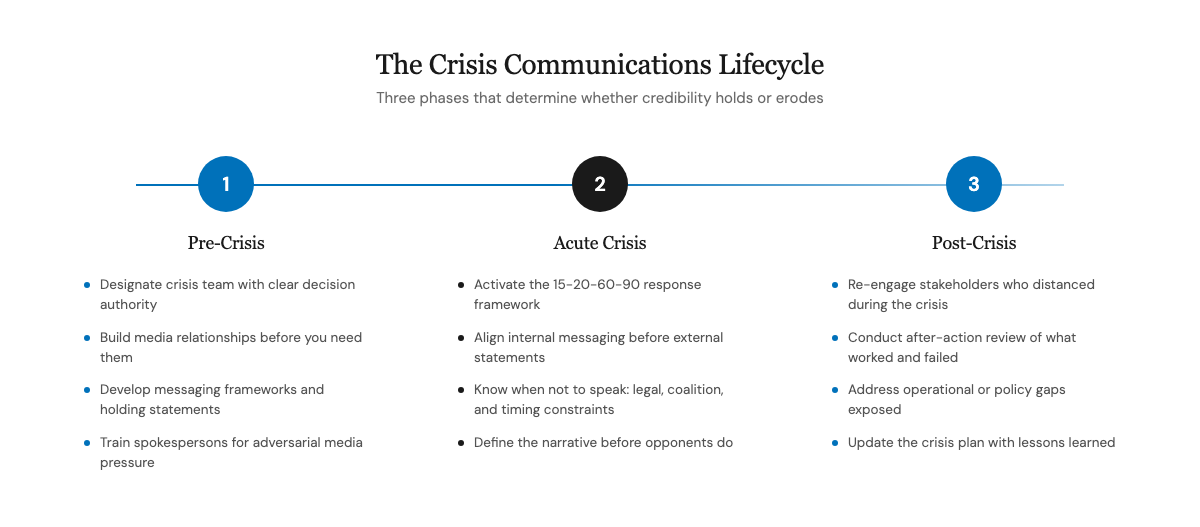
Every crisis moves through three phases. Organizations that recognize this lifecycle and prepare for each phase recover faster and with their credibility intact.
Pre-Crisis: Planning and Preparation
The most important crisis communications work happens before any crisis occurs. This is when organizations build the infrastructure that makes rapid response possible:
- Designate a crisis communications team with clear roles and decision authority
- Develop messaging frameworks and holding statements that can be adapted quickly
- Identify and train spokespersons who can represent the organization under media pressure
- Build media relationships so that when you need to reach journalists under deadline, you are a known and trusted source
- Establish stakeholder contact lists and notification protocols
- Set up monitoring systems for media coverage, social media, and regulatory developments
Organizations that skip this phase find themselves building the plane while flying it. Every hour spent making decisions about who speaks, what they say, and how to reach stakeholders is an hour the opposition, media, or public is defining the narrative without you.
Acute Crisis: The First 60 Minutes and Beyond
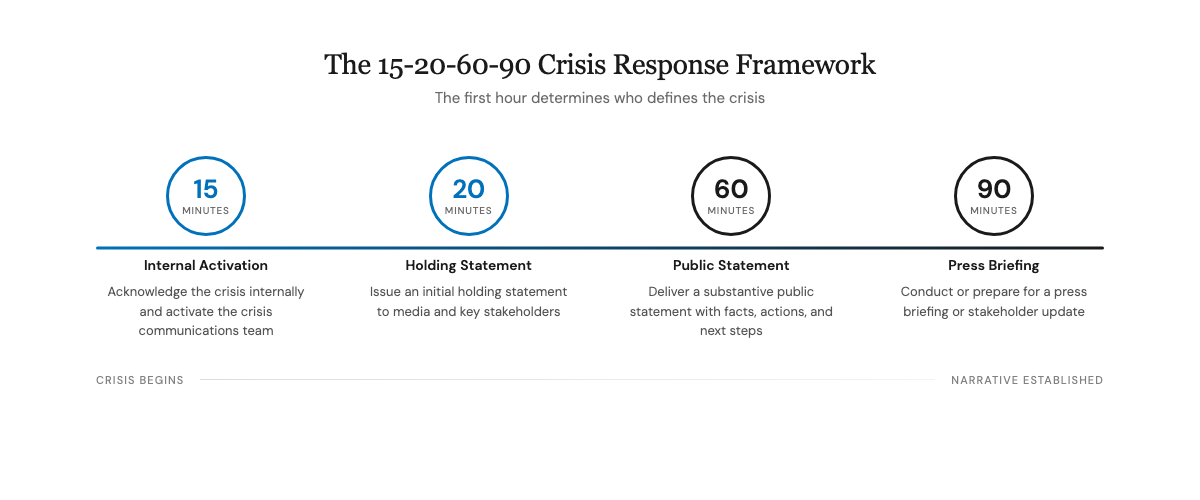
The 15-20-60-90 framework reflects the speed at which crisis communications must operate:
- Within 15 minutes: acknowledge the crisis internally and activate the crisis team
- Within 20 minutes: issue an initial holding statement to media and key stakeholders
- Within 60 minutes: deliver a substantive public statement with facts, actions being taken, and next steps
- Within 90 minutes: conduct or prepare for a press briefing or stakeholder update
These timelines are not arbitrary. They reflect the reality that in a media environment driven by social platforms and 24-hour news cycles, the organization that defines the narrative first controls the frame. Silence past the first hour invites others to fill the vacuum.
During the acute phase, internal alignment is as important as external messaging. Staff, board members, and partners need to hear from the organization before they hear from the media. If your own people are learning about the crisis from a news alert, you have already lost a layer of trust that will be difficult to rebuild.
Post-Crisis: Recovery and Institutional Learning
A crisis does not end when media coverage stops. The post-crisis phase determines whether the organization's reputation recovers fully or carries lasting damage.
Recovery requires active work:
- Re-engage stakeholders who may have distanced themselves during the crisis
- Conduct an after-action review: what worked, what failed, what was missing from the plan
- Address any operational or policy gaps the crisis exposed
- Rebuild media relationships that may have been strained
- Update the crisis communications plan based on what was learned
Organizations that skip the post-crisis phase tend to repeat the same failures. Those that invest in it emerge with stronger plans, deeper stakeholder relationships, and a clearer understanding of their own vulnerabilities.
What a Crisis Communication Plan Includes
A crisis communication plan is the operational document that turns strategy into action. It should exist before a crisis occurs and be reviewed at least annually. Ready.gov’s crisis communications planning guide outlines the baseline components every organization should have in place. A comprehensive plan covers six areas:
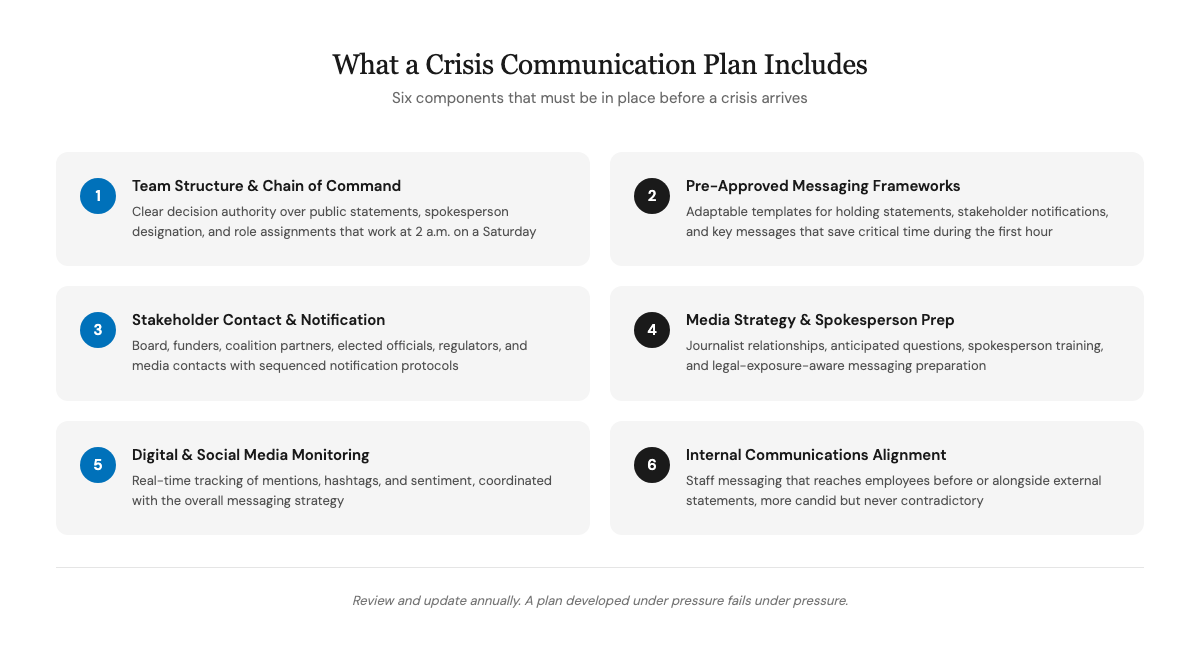
Team structure and chain of command. Who has decision-making authority over public statements? Who serves as the primary spokesperson? Who manages media inquiries, stakeholder notifications, internal communications, and digital monitoring? The chain of command must be clear enough that it works at 2 a.m. on a Saturday.
Pre-approved messaging frameworks. These are not scripts. They are adaptable templates: holding statements, stakeholder notification language, and key messages that can be customized for the specific crisis. Having these frameworks in place saves critical time during the first hour.
Stakeholder contact lists and notification protocols. Board members, funders, coalition partners, elected officials, regulatory contacts, media contacts. Each needs to be reachable quickly, and each may need a different version of the same message. The protocol defines who gets contacted in what order and through which channel.
Media strategy and spokesperson preparation. Which journalists cover your sector? Who has treated your organization fairly in the past? What are the likely questions, and how does your spokesperson answer them without creating legal exposure or contradicting the facts? Spokesperson training is not optional. It is the difference between a press conference that steadies the narrative and one that creates a second crisis.
Digital and social media monitoring. Crises now unfold on social platforms faster than in traditional media. Monitoring tools should track mentions, hashtags, and sentiment in real time. The social media response must be coordinated with the overall messaging strategy, not improvised by whoever has access to the account.
Internal communications alignment. Staff are stakeholders, and many are also potential spokespeople whether you designate them or not. Internal messaging should reach employees before or simultaneously with external statements. The message to staff should be more detailed, more candid, and more human than the public statement, but it must not contradict it.
The Role of Earned Media in Crisis Communications
Earned media, the coverage your organization does not pay for, is the most powerful force in crisis communications. It is also the most difficult to influence. The organizations that manage it well are the ones that invested in media relationships before the crisis arrived.
Earned media during a crisis is not about getting press coverage. It is about shaping the frame through which the public understands what is happening. When the frame is set by your opponents, by a hostile regulatory body, or by initial media reports based on incomplete information, every subsequent story builds on that frame. Changing it after the fact requires far more effort and carries no guarantee of success.
Effective earned media strategy during a crisis involves:
- Having established relationships with reporters who cover your sector and who trust your organization as a reliable source
- Providing journalists with accurate, timely information so they are not forced to rely solely on opposing voices
- Preparing spokespersons who can deliver key messages clearly, stay on point under adversarial questioning, and avoid the errors that generate secondary headlines
- Monitoring coverage in real time and correcting factual inaccuracies quickly
During the Save the EPA campaign, earned media was the primary strategic tool. The coalition placed union leaders and EPA employees in front of national media, including CBS Evening News, CBS This Morning, and op-ed pages of The Hill, to counter the narrative that the agency's workforce reductions were routine administrative efficiency. The communications strategy reframed the story from bureaucratic restructuring to the dismantling of environmental protection. That reframing happened through earned media, not paid advertising or social posts.
This distinction matters. Organizations that default to social media during a crisis are reaching their existing audience. Organizations that work through earned media are reaching the audiences that will decide the outcome: journalists, regulators, elected officials, and the broader public.
Crisis Communications for Mission-Driven Organizations
Crisis communications for nonprofits, advocacy organizations, public agencies, and social enterprises operates under different conditions than corporate crisis management.
For corporate brands, a crisis threatens market share and revenue. For mission-driven organizations, a crisis threatens the cause itself. When public trust in the organization erodes, it takes support for the mission with it. Donors pull back. Coalition partners distance themselves. Regulators lose a reliable voice. The policy outcomes the organization was working toward become harder to achieve, sometimes permanently.
The types of crises these organizations face are also distinct:
- Government defunding or regulatory attacks targeting the organization's mandate
- Advocacy campaigns that provoke organized opposition or political backlash
- Internal leadership failures that contradict the organization's stated values
- Coalition disagreements that surface publicly
- Environmental, public health, or civil rights emergencies where the organization is expected to respond both operationally and publicly
When communities along the Housatonic River faced decades of PCB contamination from a General Electric manufacturing facility, the crisis was not sudden. It was a long-running regulatory, environmental, and public health battle where communications strategy determined whether the issue received sustained public and political attention or faded from view. The organizations involved needed a communications partner who understood environmental science, regulatory processes, and the patience required for campaigns measured in years, not news cycles.
These are not the kinds of crises that a generalist PR firm or an emergency notification platform is equipped to handle. They require sector expertise, policy fluency, media relationships built over decades, and the judgment to know when communications strategy must defer to legal, regulatory, or coalition dynamics. A peer-reviewed study published in Climatic Change by researchers at Brown University examined the role of public relations firms in climate politics, identifying which firms advanced environmental protection and which advanced fossil fuel interests. That kind of sector-specific track record is what distinguishes a crisis communications partner from a vendor.
How to Choose a Crisis Communications Firm
When an organization decides it needs external crisis communications support, the selection criteria matter more than most realize. The wrong firm can accelerate damage rather than contain it.
Key factors to evaluate:
Sector experience. Has the firm handled crises in your specific sector, whether that is environmental, civil rights, public health, labor, or policy? Generic crisis playbooks do not account for the stakeholder dynamics, regulatory environments, and media relationships that are specific to each field.
Media relationships. Does the firm have established relationships with the journalists and outlets that cover your space? The value of a crisis communications firm is measured partly by who picks up the phone when they call.
Strategic depth. Is the firm offering tactical support, such as press releases and talking points, or strategic counsel, including narrative framing, stakeholder sequencing, and earned media strategy? In a serious crisis, you need both, but the strategic layer determines the outcome.
Speed and availability. Crises do not arrive during business hours. Can the firm mobilize a team within hours? Do they have the capacity to sustain an engagement over weeks or months if the crisis requires it?
Red flags include firms that promise guaranteed media coverage, that lack subject-matter expertise in your sector, or that treat every crisis with the same playbook regardless of context.
Frequently Asked Questions
The 5 C's are Concern, Commitment, Competency, Clarity, and Confidence. These are the qualities a spokesperson must convey during a crisis. Concern acknowledges the situation's gravity. Commitment signals the organization will act. Competency demonstrates the capacity to respond. Clarity removes ambiguity from messaging. Confidence reassures stakeholders without minimizing the reality. In practice, the 5 C's function as a self-check before any public statement: if a message fails on any of these, it is not ready for release.
The 15 20 60 90 rule is a crisis response timeline framework. Within 15 minutes, acknowledge the crisis internally and activate your crisis team. Within 20 minutes, issue an initial holding statement to media and stakeholders. Within 60 minutes, deliver a substantive public statement with facts, actions being taken, and next steps. Within 90 minutes, conduct or prepare for a press briefing or stakeholder update. The framework reflects the reality that in a media-driven environment, the organization that defines the narrative first controls the frame.
Crisis communication is how an organization talks to the public, media, and stakeholders when something goes wrong. It covers what you say, when you say it, who says it, and through which channels. The goal is not damage control or spin. It is making sure the organization's actions and intentions are understood accurately under pressure, so that decisions made by regulators, funders, journalists, and the public are based on the full picture rather than incomplete or adversarial framing.
The purpose is to protect an organization's credibility and stakeholder relationships during and after a disruptive event. That means shaping how the crisis is understood publicly, ensuring internal alignment on messaging, maintaining trust with key audiences (media, funders, regulators, staff, constituents), and laying the groundwork for recovery. For mission-driven organizations, the stakes go beyond reputation. A poorly managed crisis can undermine the policy goals, coalition partnerships, and public trust that took years to build.

Aric Caplan
Founder, Caplan Communications
Aric Caplan has advised national nonprofits, coalitions, and public agencies on high-stakes communications for more than two decades. He founded Caplan Communications in 2004, building a practice grounded in integrating earned media, message strategy, and rapid response into policy and regulatory processes. His work spans climate action, environmental protection, civil rights, and public health.

