





When the Deepwater Horizon rig exploded in the Gulf of Mexico on April 20, 2010, it killed 11 workers and began the largest marine oil spill in U.S. history. Over the next 87 days, about 3.19 million barrels of oil escaped before the well was capped. At the height of it, one of the most consequential communications tools was not a press release or a CEO apology. It was chemical dispersant. BP and the response teams used more than 1.8 million gallons of it, breaking the oil into droplets and pushing it below the surface, out of camera range. The Gulf looked cleaner. It was not.
That gap, between how something looks and what is true, is greenwashing. The way to avoid greenwashing in climate communications is to make every public claim match conduct you can document. Everything past that is decoration, and decoration is what fails the moment a reporter starts asking questions. I have spent more than two decades on the other side of that line, representing the environmental movement rather than the industries it answers to.
What Greenwashing Is
Greenwashing is environmental messaging built to manage perception rather than reflect verifiable action. It substitutes imagery, vague labels, and selective disclosure for documented conduct, making an organization or a product look greener than its record supports.
The Gulf is the clearest example I have seen, because the move was so physical. Corexit did not clean up the spill in the ordinary sense. It changed where the oil went and how it behaved. Some operational benefits may have been real, including surface control and worker safety. But the dispersant also spread contamination deeper into the water, and studies and critics have raised serious questions about whether the oil and Corexit mixture caused additional ecological harm. Oil that might have appeared as a vast black slick was redistributed through the water column and made less visible. That is the physical version of greenwashing: make the damage harder to see.
Greenwashing Takes Two Forms
Greenwashing works in two ways, and the Gulf showed both. The dispersant hid the visible oil. The branding hid the visible accountability. The first manages what you can see. The second manages who you blame for it.
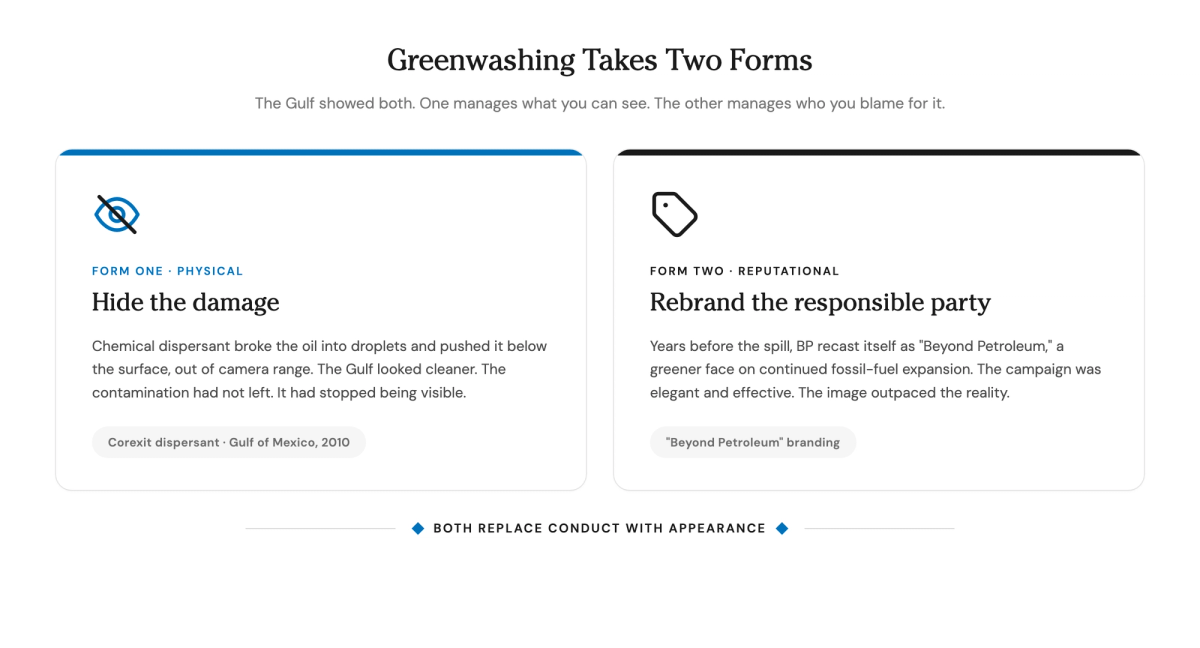
BP had a long head start on the second. Years before Deepwater Horizon, the company rebranded itself "Beyond Petroleum," presenting a greener, more climate-conscious face while remaining invested in fossil fuel expansion. The campaign was elegant, memorable, and effective. It also became one of the clearest examples of environmental branding outpacing environmental reality.
That image did not create itself. A peer-reviewed Brown University study in 2021, published in the journal Climatic Change, examined the role of public relations firms in climate politics. It found the industry's most common tactic was corporate image promotion, commonly called greenwashing, and named a small number of firms, including Ogilvy, Edelman, Glover Park Group, and Cerrell, as the major players. The study identifies Ogilvy's multi-year campaign to rebrand the oil company BP as "Beyond Petroleum," the defining example of communications recasting an oil company as a climate-aware brand.
That is not a small professional footnote. When a fossil fuel company wraps itself in climate concern while continuing the practices that worsen the crisis, the image is built by someone. Someone writes it. Someone designs it. Someone pitches it. Someone defends it. Greenwashing is never only a client-side problem. The agencies, strategists, and media advisers who supply the language are part of how it happens, which is exactly why the standard a communications firm holds itself to is the whole question.
How to Avoid Greenwashing: Four Questions Before You Publish
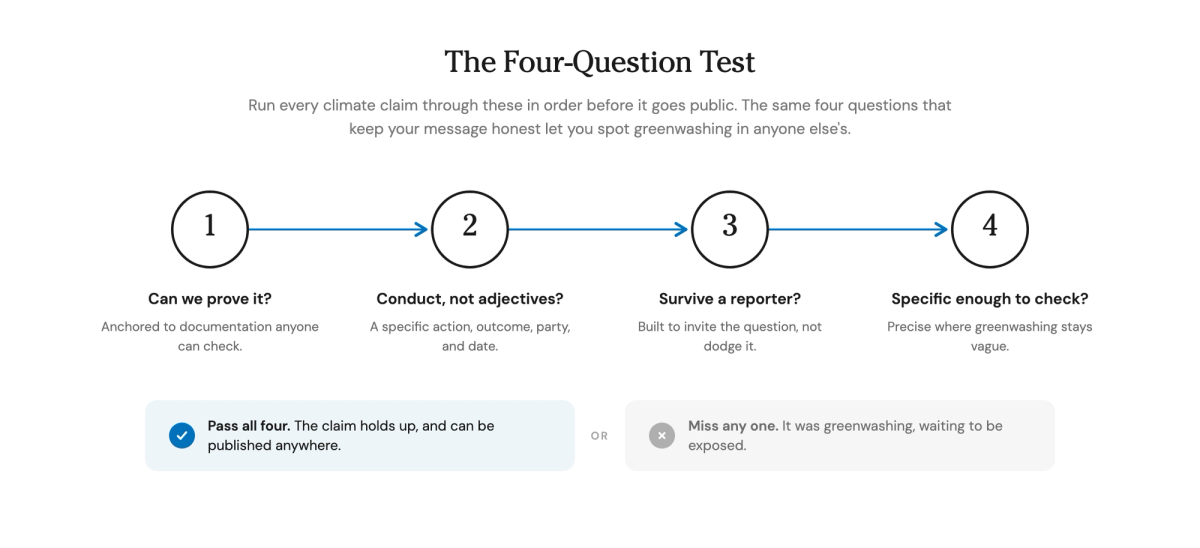
Avoiding greenwashing is less about what you say than about what you can stand behind. Before anything goes public, four questions decide whether a climate claim will hold or collapse. They are the questions I run every message through, and they work as well for testing your own communications as for spotting greenwashing in someone else's.
1. Can we prove it?
Say only what the documentation supports. A claim a reporter, a regulator, or a court could check is a claim that holds. One that floats free of evidence is greenwashing waiting to be exposed.
When communities along the Housatonic River faced decades of PCB-contaminated sediment from a General Electric facility, the communications worked because they named the conduct precisely: the contamination, the responsible party, and the documented record of harm. We did not say the river deserved protection and leave it as sentiment. We reported what had been done to it, and by whom. The strength was never in green language. It was in facts that could not be waved away.
2. Are we reporting conduct, or reaching for adjectives?
Greenwashing lives in words like green, clean, and sustainable. They sound like claims but commit to nothing. Credible communications report conduct instead: a specific action, a measurable outcome, a named party, a date. Conduct can be verified. Adjectives cannot.
Sinking the oil in the Gulf produced an adjective, cleaner, with nothing underneath it. If you removed every flattering adjective from your climate messaging, what verifiable conduct would be left standing? Whatever remains is the real communication. The rest was packaging.
3. Will it survive a reporter's questions?
The discipline that keeps climate communications honest is earned media. It is public visibility you don't buy or fully control: coverage a reporter, editor, producer, host, or publication decides is newsworthy enough to share. Paid messaging asks you nothing. A journalist asks you everything, and will not put their name on a claim they cannot stand behind. If the strongest version of your claim could not run in a credible outlet without a correction, it is not ready.
For more than twenty years our work has run through reporters who check, not advertisements that do not. That filter is not a limit on the message. It is what makes the message worth trusting. The narrative strategy behind a credible climate campaign is built to invite scrutiny, not to survive only as long as no one looks closely.
4. Are we specific enough to be checked?
Vagueness is the tell, and it is also the test. The same question that keeps your own messaging honest lets you spot greenwashing in anyone else's: look for the claims that cannot be checked. A "carbon neutral" badge that rests on purchased offsets rather than reduced emissions. One favorable metric disclosed while the rest of the record stays hidden. A recyclable label on a product almost no facility accepts. Each offers a detail that sounds true to imply a claim the evidence will not support. Specificity is what greenwashing cannot survive, which is exactly why credible organizations reach for it.
Put the four questions side by side and the line between greenwashing and credible work is easy to see.
| The question | Greenwashing | Communications that hold up |
|---|---|---|
| Can we prove it? | Floats free of evidence | Anchored to documentation anyone can check |
| Conduct, or adjectives? | Green, clean, sustainable | A specific action, outcome, party, and date |
| Will it survive a reporter? | Built for an audience that will not ask | Built to invite the question |
| Specific enough to check? | Vague by design | Precise enough to be verified |
What the Independent Record Shows
The hardest claim to make credibly is a claim about yourself. The most useful evidence on whether a firm greenwashes is not its own statement. It is an independent record.
The same Brown University analysis mapped how public relations firms shaped climate politics from 1988 to 2020, across five sectors: coal, oil and gas, utilities, renewable energy, and the environmental movement. The bulk of the industry's effort served fossil fuel interests. The environmental movement engaged the fewest firms of any sector, and within it the work was concentrated in a single firm. Caplan Communications accounted for more than 25 percent of all public relations hirings for the environmental movement, and 96 percent of our own work was performed for it.
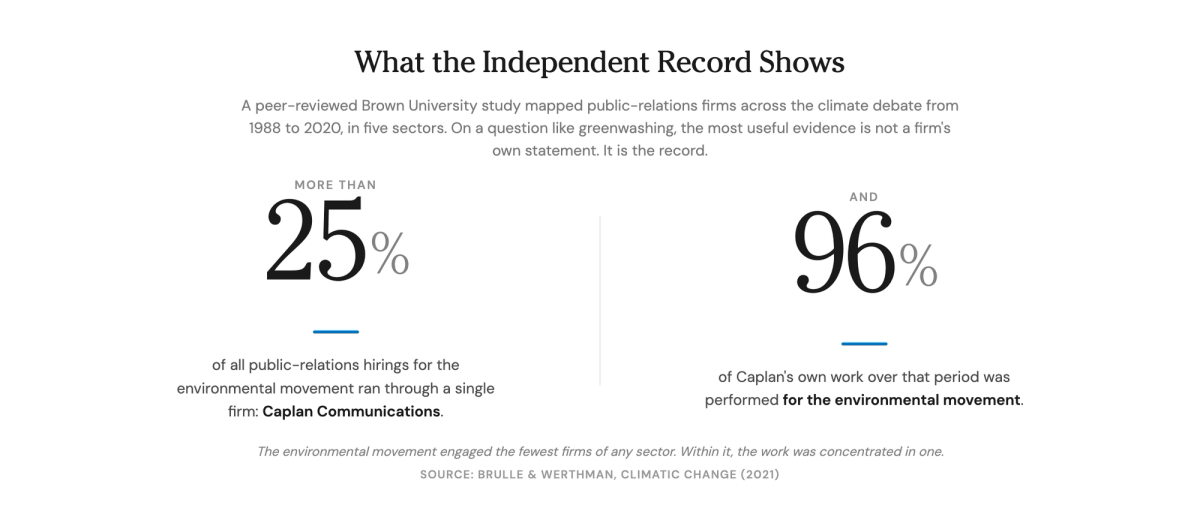
The study did not set out to certify anyone. It recorded the side each firm was on. For a question like greenwashing, that record carries more weight than anything a firm could say about itself.
The Gulf should be remembered not only for the oil that poured into the water, but for the systems that made the damage look more manageable than it was. Some of those systems were chemical. Some were communications. The question for our work is never whether we can make an organization look responsible. It is whether the responsibility is actually there, and whether the communications reveal that truth or help conceal it below the surface. The organizations we represent, from American Rivers to the Union of Concerned Scientists, are not working to look like they are doing the work. They are doing it. The communications only have to keep up.
Frequently Asked Questions
Greenwashing can cross into illegal territory when it becomes deceptive advertising. In the United States, the Federal Trade Commission's Green Guides set out how environmental claims must be substantiated, and unsupported claims can draw enforcement. Most greenwashing is never litigated, though. It is exposed, by reporters and researchers, and the cost is paid in lost credibility long before it is ever paid in court.
Greenwashing manages perception. Credible climate communications report conduct. The difference is verifiability: one is built to be checked, the other depends on no one checking. If a claim cannot survive a specific question, it was never communication. It was packaging.
Yes, and the ones with a real record do it constantly. The line is not how much you say. It is whether what you say is anchored to conduct. Specific, documented, checkable claims are not only safe from the charge of greenwashing. For an organization with a genuine record, they are the case.

Aric Caplan
Founder, Caplan Communications
Aric Caplan has advised national nonprofits, coalitions, and public agencies on high-stakes communications for more than two decades. He founded Caplan Communications in 2004, building a practice grounded in integrating earned media, message strategy, and rapid response into policy and regulatory processes. His work spans climate action, environmental protection, civil rights, and public health.


