





Climate Week NYC is just a moment, not a strategy. This year, the spotlight focused on Energy. Impact. Action. But the challenge is no longer simply setting ambition. It is implementation.
How quickly can the world build a clean, secure energy system? How do we finance climate solutions at scale amid economic and geopolitical uncertainty? How do we meet rising electricity demand, modernize grids and accelerate progress without losing public support or political momentum?
Those are not one-week questions. And they will not be answered by a week of announcements, panels, pledges or headlines. What carries beyond Climate Week depends on who people believe, where the stakes are felt and which decisions the work is designed to influence.
Climate Week concentrates extraordinary attention on consequential problems. The mistake is treating that concentration of attention as the strategy itself.
In February the Environmental Protection Agency rescinded the endangerment finding, the 2009 determination that greenhouse gases endanger public health and welfare and the legal trigger connecting climate science to the Clean Air Act. Administrator Lee Zeldin finalized it on February 12. The rule was published on February 18, and that same day the Natural Resources Defense Council and more than a dozen health and environmental organizations sued, with a coalition of states and cities litigating alongside them. It took effect on April 20. Our work for NRDC defended that finding when it was under threat, using earned media and rapid response to translate a highly technical regulatory fight into its consequences for public health, energy, vehicle policy and communities.
The heart of the case now in the D.C. Circuit is that rescinding the finding is antithetical to the agency's own stated purpose, which still commits it to protecting human health and the environment and to basing environmental risk decisions on the best available science. What EPA actually did in the final rule has been widely misread. It did not rest the rescission on a determination that the 2009 science was wrong. It adopted a new legal interpretation of the Clean Air Act, and argued separately that regulating American vehicle emissions is so ineffectual against global temperature and sea level projections that keeping the standards is unreasonable. And NRDC has not lost the case. It hasn't really been argued yet. The immediate fight is over what record the court will review and when merits briefing begins.
Seven months later, 100,000 people were expected in Manhattan under "Energy. Impact. Action." to talk about electrification, while the legal foundation beneath federal climate policy had been pulled out. That contrast is the point.
Climate Week is a news cycle. It is not a strategy.
A thousand announcements at Climate Week NYC, and one "news hole"
Climate Week NYC 2026 ran September 20 to 27. For the reporters who covered it, that was one week. The national climate and energy desks are a small group of people. Every organization in town wants the same dozen of them on the same four days, and the "news hole," the space a desk has for climate in a given day, does not grow because the number of press releases did.
Most announcements never reach those reporters. The ones that do land for one reason: they changed something for someone who was not in the room. A reporter does not cover a panel. A reporter covers what changes because of it, for people who were never there.
We have anchored Environmental Entrepreneurs' reports in the news cycle since 2008, and the lesson has not changed in eighteen years. The report is not the story. The business owner in a real market, saying what the numbers mean for her payroll and her customers, is the story. The report gives her the standing to say it.
A frame people outside the room can feel
Climate Week opened in the last stretch of "Danger Season," the frame we defined and advanced with the Union of Concerned Scientists for the months from May through October, when extreme heat, wildfire smoke, hurricanes and grid stress arrive together and compound. The point was never the name. It was that climate stopped being a projection and became the week people were having: the heat advisory, the smoke over the school, the power that went out.
By the time the Opening Ceremony convened on September 21, Danger Season had been running for five months. The most credible thing anyone could say in New York that week was what those five months did to the people they serve, in the places they serve them. Speak to the week people are having, not the week the conference is having.
A messenger the audience already believes
The delegation matters more than the deck. The "I Will" Act on Climate bus tour took climate action through thirty states on the voices of local business owners, faith leaders, union members, public health professionals and people living with the damage, and climate moved from a policy-circle cause to a community-level concern tied to jobs and health. The same rule has held for Environmental Entrepreneurs since 2008, where the messengers are business leaders and investors and the argument is economic.
It holds hardest right now for the organizations whose mandate is scientific integrity. NRDC, the National Wildlife Federation and the Union of Concerned Scientists are working on the leading edge of that fight while suing the agency charged with defending human health and the environment for failing to do it. They have spent decades earning the standing to say what follows. The fox is not just guarding the henhouse. It's torching it.
Who you bring to New York, and who you put in front of the reporter you finally reach, is the strategy.
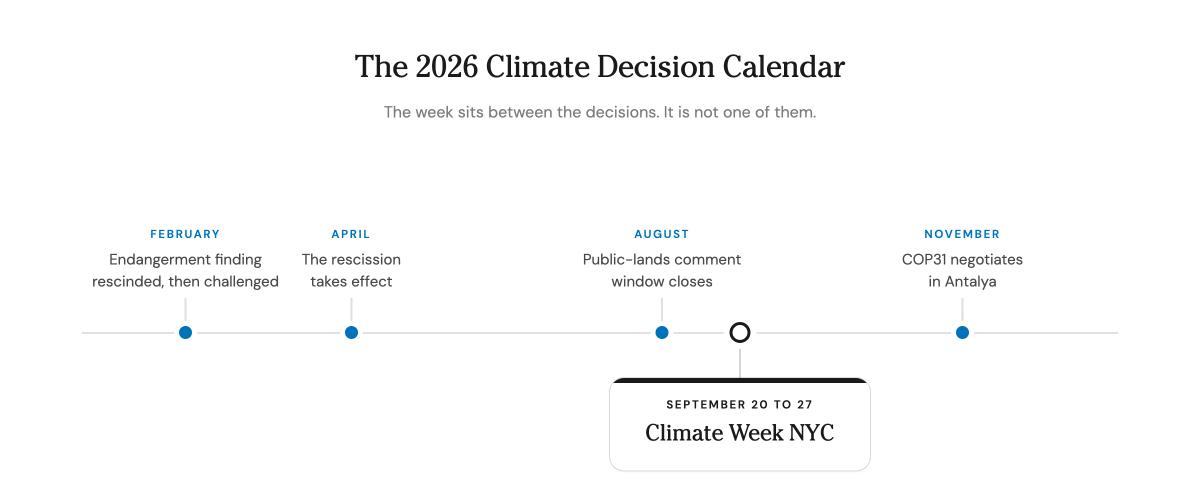
A decision the work is pointed at
Climate Group's own line for this year's policy track was the most honest sentence in the program: "The transition doesn't need more ambition, it needs decisions." Agreed. Decisions are made by people, in courts, agencies, legislatures and utility commissions, and those people act when the stakes have been made impossible to miss. That is communications work, and almost none of it happens in Manhattan in September.
The calendar around the week is full of actual decisions. The D.C. Circuit on the endangerment finding. The Interior Department's rollback of oil and gas safeguards on public lands, whose public comment period closed on August 24, weeks before the first panel; the deadline did not wait for the conference, and neither did our work with the National Wildlife Federation. State legislatures that convene in January and utility commissions that never recess. COP31 in Antalya, November 9 to 20, where governments negotiate what New York can only announce.
When we designed the Save the U.S. EPA Campaign for AFGE Council 238, the union representing roughly 9,000 EPA scientists, engineers and public health professionals, every piece of it was timed to a policy development. Nothing ran because a date on a conference calendar arrived. It ran because a decision was about to be made and the people making it needed to see what it would cost. The same discipline applied when the week's news broke. The organization with a standing rapid-response function answers it the same day. The rest issue a statement on Friday, after the desks have moved on.
So the test for Climate Week is not what happens in New York. It is what you carry into the city from outside it, a frame people can feel, a messenger they already believe, a decision the work is aimed at, and what you carry out when the week ends. That has been our work since 2004, in climate and clean energy, environmental protection and public health, from Greater Washington to the markets where decisions land. It was documented in a 2021 peer-reviewed analysis of how public relations firms shape climate politics.
If you're navigating a high-stakes communications challenge, we'd welcome a conversation.
Frequently Asked Questions
When was Climate Week NYC 2026, and how long did it run?
Climate Week NYC 2026 ran from Sunday, September 20 through Sunday, September 27, in New York City, alongside the United Nations General Assembly. The Opening Ceremony was Monday, September 21, and The Hub Live ran September 21 and 22. The official program is published at climateweeknyc.org.
What is Climate Week NYC, and who runs it?
It is the largest annual climate gathering in the world, founded and run by Climate Group, an international nonprofit. In 2025 it drew more than 100,000 people to more than a thousand events across the five boroughs.
Who attends Climate Week NYC, and is it free?
Businesses, NGOs and nonprofits, government agencies, universities, community and cultural organizations, and media. Most events in the citywide program are free to attend. The Opening Ceremony and The Hub Live are invitation-only and streamed online.
What was the theme for Climate Week NYC 2026?
The 2026 strapline was "Energy. Impact. Action." The program ran across twelve themes, from energy and electrification to climate and health, environmental justice, and policy, governance and leadership.
What is the difference between Climate Week NYC and COP31?
Climate Week NYC is a convening: events, announcements and meetings, with no negotiating mandate. COP31 is the United Nations climate negotiation, held November 9 to 20, 2026, in Antalya, Türkiye, where governments negotiate commitments. The narrative built in September carries into November.
How does the EPA endangerment finding rescission change climate advocacy in 2026?
Administrator Lee Zeldin finalized the rescission on February 12, 2026. The final rule was published February 18 and took effect April 20. It is being challenged in the D.C. Circuit by NRDC and more than a dozen health and environmental organizations, with a coalition of states and cities litigating alongside them. Two things are widely misunderstood. EPA did not rest the rescission on a finding that the 2009 science was wrong; it adopted a new legal interpretation of the Clean Air Act and argued that regulating American vehicle emissions is too ineffectual against global projections to be worth keeping. And the case has not been lost. It has not really been argued yet. For advocates, the fight has moved to the courts, the states and public opinion, and communications has to be aligned to those decisions, not to the conference calendar.

Aric Caplan
Founder, Caplan Communications
Aric Caplan has advised national nonprofits, coalitions, and public agencies on high-stakes communications for more than two decades. He founded Caplan Communications in 2004, building a practice grounded in integrating earned media, message strategy, and rapid response into policy and regulatory processes. His work spans climate action, environmental protection, civil rights, and public health.


